AI Visibility Tools: What to Track Before Choosing a Platform
Most teams track how often their brand appears in AI search results.
 Mira Chen11 min read
Most teams track how often their brand appears in AI search results. That number alone tells you nothing about actual influence or whether the appearance drives trust. The real question is which metrics predict real impact. This guide breaks down AI Visibility Tools: What to Track Before Choosing a Platform into five concrete filters. You'll learn how to separate signal from noise, avoid common tracking traps, and pick a tool that measures what actually moves your brand in generative search. Here's the shortcut most buyers miss.
Why Should You Track AI Visibility Before Evaluating a Platform?
Most teams jump straight into comparing tool features. That order is backwards. You need to know what you're measuring before you decide how to measure it. AI visibility is not a side metric anymore. It's becoming a core brand signal. Pick the wrong tool, and you'll either drown in vanity numbers or miss the data that actually drives decisions.
The Shift From Traditional SEO to AI-Driven Brand Monitoring
Search engines no longer just rank pages. They generate answers from multiple sources, including blogs, forums, product pages, and user comments. Your brand's visibility in those answers depends on whether your content gets cited, how often, and with what context.
Traditional SEO tracked clicks and impressions. AI visibility tracks whether your brand gets mentioned in a response, and whether that mention builds trust or gets buried. A high rank on page one of Google means little if an AI assistant never pulls your content. The metric has shifted from "where you appear" to "whether you're used."
This changes how you evaluate tools. A platform that only counts appearances won't tell you if those appearances drive confidence. You need to track citation frequency and sentiment together.
The Cost of Choosing the Wrong Tool Too Early
Picking a tool before you define your KPIs leads to three common problems:
Wasted budget. You pay for features like sentiment analysis or entity extraction, but never use them because they don't align with your actual goals.
Data that doesn't fit your workflow. If your team already tracks brand mentions via another system, adding a tool that produces incompatible metrics creates more confusion than clarity.
Integration headaches. Some tools export data in formats that require manual rework. If your analytics stack expects JSON and the tool gives you CSV, you'll spend more time cleaning data than analyzing it.
The smarter move: decide what you need to measure first, then match the tool to those needs. Start with a free tier or a trial run against your own brand data. That gives you real feedback before you commit budget.
What Metrics Should an AI Visibility Tool Actually Track?
Most tools pitch you a single number: brand mentions in AI responses. That number alone misleads. You need at least four data points to know whether your AI presence actually works. This breakdown of AI Visibility Tools: What to Track Before Choosing a Platform focuses on the metrics that separate signal from vanity.
Brand Mention Frequency and Coverage Across Models
Different LLMs, including GPT-4, Gemini, Claude, Llama, and Perplexity, respond differently to the same query. One tool may show your brand in ChatGPT but not in Claude. That gap matters because users search across models. Track coverage per model and by query type: navigational, informational, and transactional. If you only appear in informational queries but never in navigational ones, you're missing direct intent.
Sentiment and Context of Citations
A mention means nothing if the LLM frames your brand negatively or attributes you to the wrong topic. Look at the snippet text around your brand. Is it referencing your product in a useful comparison, or as a warning example? Tools that only count appearances without showing context let bad signals slip through. You need to see whether the AI treats your brand as a source or as an example to avoid.
Share of Voice Compared to Competitors
Your raw mention count is misleading unless you compare it to competitor frequency in the same queries. If you appear 50 times but your top competitor appears 200 times, your share of voice is weak. Track over time because share fluctuations often correlate with content updates, news coverage, or documentation changes. Benchmarking against competitors tells you if your AI visibility is improving or falling behind.
Source Attribution and Authority Signals
Which pages or content pieces drive your AI citations? A good tool shows the exact URLs LLMs prefer. If your homepage never cites itself but a blog post from 2022 is used constantly, you know where to invest. Also track the authority of sources cited alongside you. If your brand appears only with low-trust sources, the AI's perception of your credibility may be weak.
What Technical Capabilities Should You Look For?
Picking an AI visibility tool means looking past the dashboard. You need three technical layers to judge: how fast it updates, how you get the data out, and what queries it actually covers.
Real-Time vs. Batch Tracking
Real-time tools refresh data every few minutes. That matters when a competitor launches a product or a viral post changes how AI models describe your brand. If you're monitoring crisis scenarios or fast-moving campaigns, real-time is the only way to catch ephemeral responses, meaning answers that disappear hours later.
Batch tracking is cheaper. It runs daily or weekly reports. Use it for routine brand health checks. But know the trade-off: you will miss short-lived shifts. If your tool only batches, you are looking at a rearview mirror.
API Access and Data Export Options
A closed dashboard is a trap. Check whether the tool gives you a REST API to pull raw data into your BI system, such as Tableau, Looker, or a simple spreadsheet. Also confirm export formats: CSV and JSON cover most needs. Some platforms offer dashboard embedding for team sharing without login friction.
Without API access, your analysis stays inside the tool's UI. That limits cross-referencing with other metrics like web traffic or ad spend. For any serious setup, API is non-negotiable.
Query Coverage and Customization
Not all tools let you define your own seed queries. You want the ability to monitor both broad branded terms and long-tail phrases like "secure messaging app for small teams" or "budget CRM for startups." Industry jargon matters too. If your software uses domain-specific terms, the platform must track those.
The critical test: ask if you can add, pause, or rotate queries without a support ticket. If you can't, the tool lacks the flexibility to follow your market's changing language.
How Does the Tool Fit Into Your Existing Workflow?
A tool that sits apart from your current setup creates more work, not less. Before you commit, check two things.
Integration with SEO and Analytics Platforms
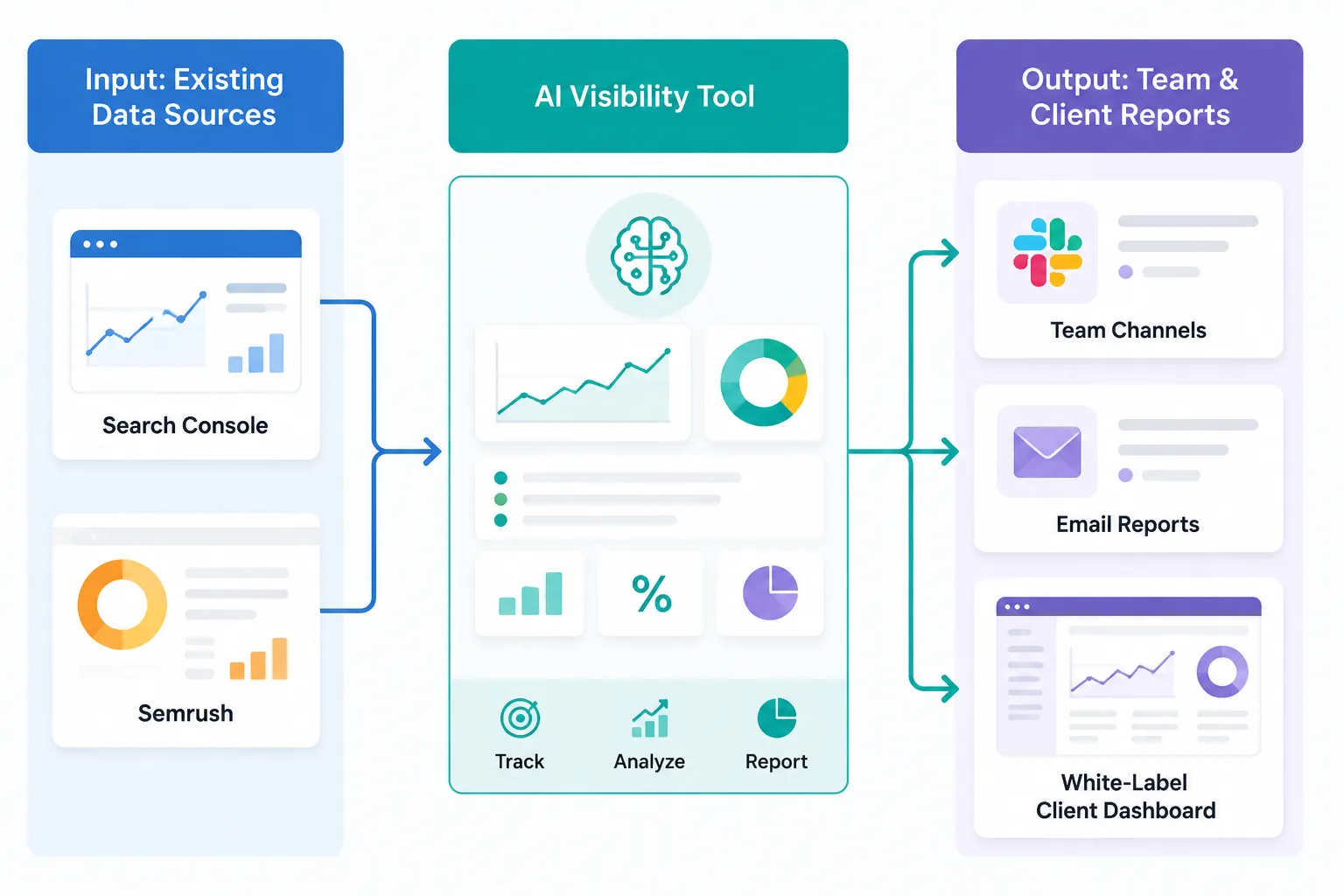
Does the tool connect to the platforms you already use? Many AI visibility tools claim general compatibility, but the real test is whether they sync with Google Search Console, Semrush, or a custom dashboard. Native integrations save time and reduce manual errors. You shouldn't need to export CSV files and upload them somewhere else every week. Look for direct connections that pull data automatically. If a tool requires constant manual imports, it will likely fall out of use within a month.
Team Collaboration and Reporting Features
Who needs to see the data? If you work alone, basic dashboard access might be enough. But agencies and larger teams need more.
Automated reports sent to email or Slack keep everyone aligned without extra meetings. User permissions become critical when multiple people access the same account. You want to control who can edit settings or view sensitive data. White-label options matter for agencies reselling insights; your clients shouldn't see another brand's logo.
Here's the short version: a tool that fits into your existing workflow is one you can set up once and forget. If it requires daily babysitting, it's not saving you time. It's creating overhead. Focus on tools that plug into what you already use and let your team access results without jumping through hoops.
What Pricing and Scalability Factors Should You Consider?
You can have the best tracking setup, but if the pricing model doesn't match your scale or your monitoring frequency, you'll either overpay or hit limits when you need them most. Flat-rate pricing is the safest bet for growing portfolios because it keeps costs predictable as you add brands and queries.
Pricing Models: Per-Query vs. Per-Brand vs. Flat-Rate
Each model forces a tradeoff between flexibility and cost control.
| Model | Best for | Hidden trap |
|---|---|---|
| Per-query | Low-frequency tracking or single-brand | Costs spike fast if you increase monitoring frequency or add queries later |
| Per-brand | Mid-size teams with clear brand boundaries | Limits query diversity because you pay for a whole brand even if you only track a few queries |
| Flat-rate | Growth-stage teams or agencies | Higher upfront monthly cost, but no surprise spikes as you scale |
Per-query sounds cheap at first. But if you decide to monitor 50 queries instead of 10, your bill can jump 5x overnight. Flat-rate pricing removes that anxiety because you know your cap from day one.
Scalability for Growing Brand Portfolios
Many tools work well for a single brand but buckle when you add a second or third. You need to check three things before you commit:
- Can the tool handle at least 100+ queries across multiple brands and competitors?
- Does it have tiered plans that let you upgrade without migrating data?
- Will adding a new brand require a separate account or a pricing renegotiation?
The tools that score high on AI Visibility Tools: What to Track Before Choosing a Platform usually offer tiered flat-rate plans. They let you start small and move up without renegotiating contracts or rebuilding dashboards. That's the practical path, not a promise of "unlimited everything" that turns into a support ticket when you actually use it.
How Can You Test an AI Visibility Tool Before Committing?
When evaluating AI Visibility Tools: What to Track Before Choosing a Platform, the smartest approach is a real-world trial. Run a proof-of-concept with 10 to 20 of your own branded and competitor search terms. Feed each through the tool, then manually check the same queries in ChatGPT, Perplexity, or Gemini. Compare the results side by side. If the tool misses obvious appearances or invents false ones, walk away.
The most critical signal is how the tool handles edge cases: a recent article, a brand nickname, a niche industry term. If it fails there, it won't scale for daily tracking.
Run a Proof-of-Concept With Your Own Queries
Don't rely on the tool's example queries. Use the terms your team actually monitors, including your company name, product names, and top competitors. A reliable tool should surface appearances you can verify manually within a few minutes. If it reports a mention you can't find in a direct AI search, that's inflated data.
Evaluate Support and Documentation
Test how easy it is to get help during the trial. Check the knowledge base, API docs, and community forums. Ask a specific question via chat or email. Note the response time. If support takes more than 24 hours during a trial, expect worse after purchase. Documentation that reads like marketing copy, heavy on promises and light on technical detail, suggests the product may not be ready for real users.
Frequently Asked Questions
What is an AI visibility tool?
It tracks how often and in what context your brand appears in responses from generative AI models like ChatGPT, Gemini, and Perplexity. This helps you understand your brand's AI presence and find opportunities to improve.
What is the most important metric in AI visibility tools?
Brand mention frequency is the baseline. Sentiment, source attribution, and competitor share of voice provide the actionable context needed for content strategy.
Do I need a separate tool for AI visibility if I already use an SEO tracker?
Yes. Traditional SEO tools do not monitor LLM responses directly. A dedicated AI visibility tool is better suited for measuring model mentions, source attribution, and cross-platform answer coverage.
How often should AI visibility data be updated?
For fast-moving campaigns or reputation issues, use daily or real-time updates. For weekly reporting, batch updates may be enough. Choose a cadence that matches your content refresh cycle.
Tracking the right metrics before selecting an AI visibility platform ensures your investment aligns with your brand's actual visibility needs. Focus on data sources, update frequency, and coverage depth to make an informed choice.
Author
Mira Chen
Mira Chen studies how global brands appear in AI answer engines and turns that evidence into practical GEO workflows.