Best AI Search Visibility Tools for Brands in 2025
Compare the best AI search visibility tools for tracking brand mentions, citations, and answer-engine coverage across major AI platforms in 2025.
 Mira Chen11 min read
Your brand's visibility in AI search is no longer optional. ChatGPT, Perplexity, and Google AI Overviews now generate answers without sending users to your site. Yet most companies still improve only for traditional search. That mismatch costs traffic and trust. This guide breaks down the best ai search visibility tools 2025 — tools that combine LLM tracking, AI overview monitoring, and content optimization. These platforms help you stay visible across all major AI answer engines. Here's what to look for and which tools deliver.
Why AI Search Visibility Matters in 2025
How AI Search is Changing Brand Discovery
Search used to work like a library. You typed a question, got a list of websites, and clicked the most promising link. That model is breaking apart.
AI answer engines — ChatGPT, Perplexity, Google AI Overviews, Bing Chat — now generate answers directly in the search result. They pull facts from multiple sources, summarize them, and present a single response. The user gets an answer without visiting any site. These are called zero-click answers.
The impact on organic traffic is real. When a user’s question is fully answered by AI, they have no reason to click through to your content. Even if your site is cited as a source, the link often appears in a collapsible section or at the bottom of a long block. Many users never scroll that far.
That shift changes what "visibility" means. Showing up in a search result is no longer enough. Your brand needs to be inside the answer itself. Being cited in AI responses is becoming a new performance metric — one that traditional SEO tools don’t track.
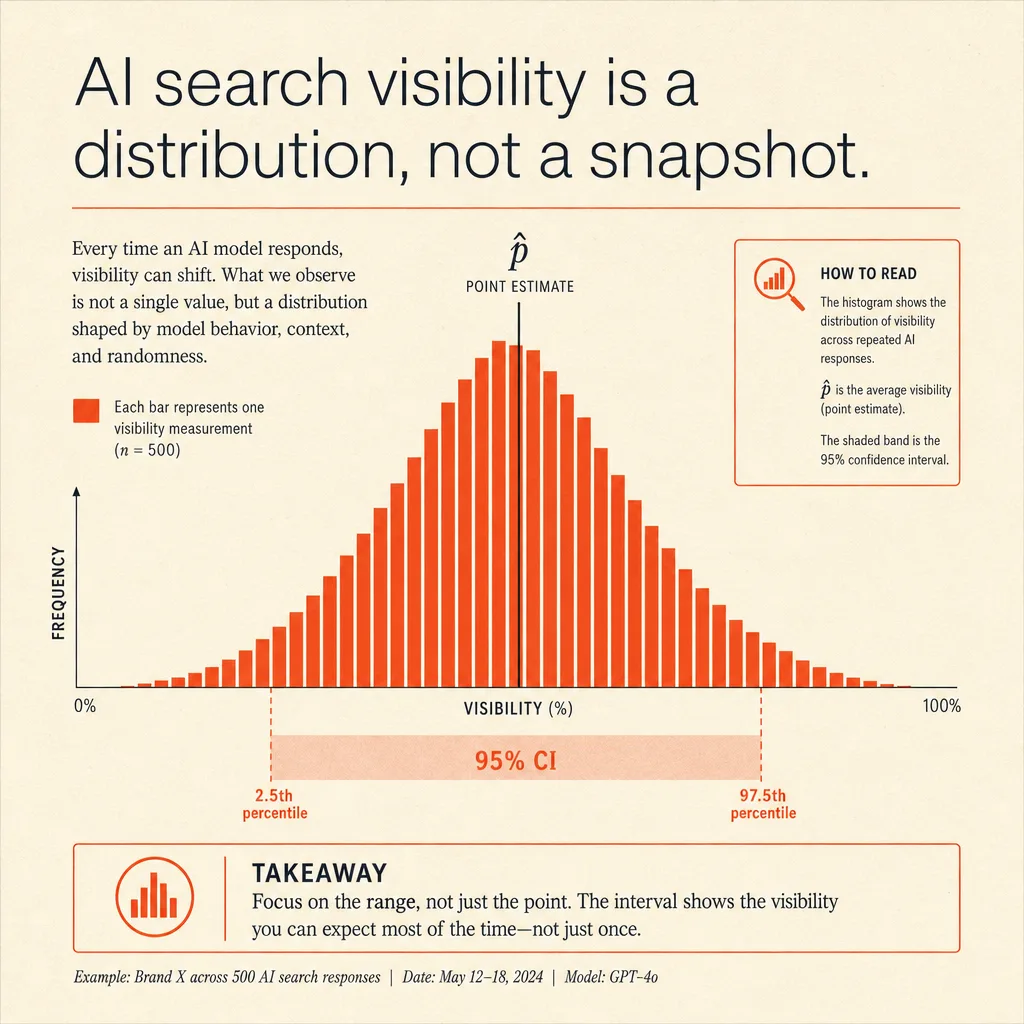
Before you evaluate platforms, define the AI search visibility metrics your team will use consistently. A tool comparison is only useful if every vendor is judged against the same mention, citation, position, sentiment, and assisted demand framework. For the broader buying checklist, use the dedicated guide to AI search visibility tools.
The Three Pillars of AI Visibility
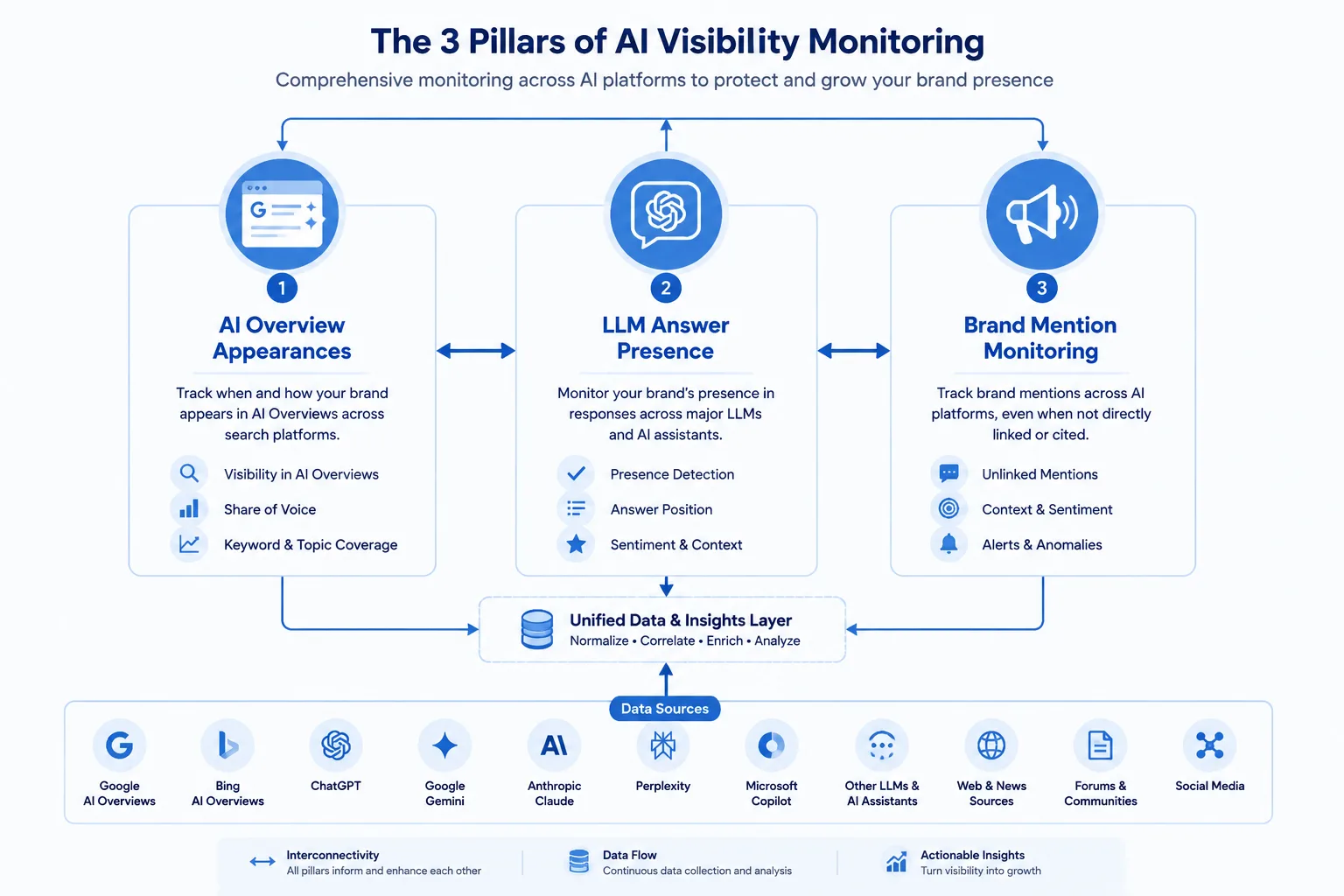
To measure and improve your AI search visibility, you need to track three separate areas.
1. AI Overview appearances — These are the summary boxes you see in Google Search (sometimes called SGE) and Bing Chat. They cite sources and sometimes show product links. If your brand is missing from these overviews, you lose the most visible real estate in search.
2. LLM answer presence — Large language models like ChatGPT, Claude, Perplexity, and Gemini generate answers in chat interfaces. These platforms have their own ranking logics. Your content needs to be included in their training data, and more importantly, cited in real-time answers. This is harder to monitor than traditional search.
- Brand mention monitoring across AI-generated content — AI models sometimes invent citations or misattribute quotes. You need to know when your brand is mentioned — correctly or incorrectly — in AI outputs. This is not just about visibility; it’s about reputation control.
These three pillars operate differently. A tool that tracks Google rankings won’t tell you whether ChatGPT cites your product page. That’s why the best ai search visibility tools 2025 are purpose-built for this new landscape. They combine LLM tracking, overview monitoring, and content optimization in one platform. Without such a tool, you’re flying blind in AI-generated search.
The key takeaway: if you only improve for traditional search today, you’re optimizing for a shrinking slice of traffic. AI visibility is not a future trend — it’s already how a growing number of users find answers.
What to Look for in an AI Search Visibility Tool
When you shop for the best ai search visibility tools 2025, the first thing to check is what they actually track. Many tools claim to monitor AI search, but their coverage varies. Here are the features that separate useful platforms from hype.
Core Tracking Capabilities
Real-time response monitoring matters most. You need to see how your brand appears in ChatGPT, Perplexity, Google AI Overviews, Claude, Bing Chat, and Gemini — not just one or two. If a tool only covers ChatGPT, you miss half the picture.
Historical data is just as critical. A snapshot today tells you little. You need to compare visibility over weeks or months to spot trends. Did a new competitor push you out? Did an algorithm update drop your brand? Without history, you’re guessing.
A tool that offers live alerts for brand mentions or sudden drops gives you time to react. Without that, you find out days later.
| What to Track | Why It Matters |
|---|---|
| Which AI platforms are covered | Miss one, lose traffic from that channel |
| Real-time vs. delayed data | Delayed data = lost opportunity to fix issues fast |
| Historical comparison | See if changes are temporary or permanent |
Optimization & Reporting Features
Coverage alone isn’t enough. A good tool tells you where to improve.
Content gap analysis shows which topics your competitors rank for on AI platforms but you don’t. That’s where you should focus your next content.
AI readiness scoring rates each page or topic on how likely it gets pulled into AI answers. Low score? You know what to fix — structure, clarity, authority signals.
Custom reports let you share progress with your team or clients. Real-time alerts for brand mention drops or new entrants help you act before the problem spreads.
Pricing and Scalability
Paid plans typically range from $50 to $500 per month. Free tiers exist but are limited — often only one platform or very few queries.
Watch for hidden costs. Some tools charge per query after a cap. Others add fees for extra users or API access. A $200 plan can quickly turn into $600 if you need three team seats.
For agencies or enterprises, check if the tool supports multiple projects under one account, allows custom APIs, and scales with your team size without price jumps.
A cheap tool that misses key platforms or lacks historical data is no bargain. Spend on coverage and real-time tracking first. Add reporting features later. That approach gives you the most value — and keeps your brand visible where AI answers start.
The 7 Best AI Search Visibility Tools for 2025
The tools below cover three things: tracking where your brand appears in AI answers, spotting problems early, and helping you adjust content so you stay visible. Pricing ranges from $49/month to enterprise-only quotes. No tool does everything, so pick the one that matches your team size and risk tolerance.
| Tool | Starting Price | Best For |
|---|---|---|
| Evertune AI | $199/month | Broadest platform coverage (10+ AI engines) |
| Profound | Custom quote | Enterprise compliance and maximum engine count (15+) |
| Peec AI | $99/month | Geographic filtering and content gap analysis |
| Otterly AI | $49/month | Quick setup with pre-configured alerts |
| SE Visible | $79/month | Combining traditional SEO with AI monitoring |
| Ahrefs Brand Radar | Included with Ahrefs Enterprise ($399+/mo) | Existing Ahrefs users wanting directional AI insights |
| Scrunch AI | $149/month | Misinformation detection and proactive optimization |
Pricing alone won't tell you which tool fits. The real test is whether it covers the AI engines your audience uses.
Evertune AI – If you need eyes on more than just ChatGPT and Perplexity, this one covers niche engines like You.com and iAsk. The platform scores your content's AI readiness and suggests edits to improve visibility. Starter plan at $199/month gives you up to 5 monitored brands.
Profound – Built for teams that need SOC 2 and GDPR compliance. Tracks 15+ AI engines, including specialized ones. You'll need to contact sales for pricing. Good if legal or procurement requires formal security reviews.
Peec AI – Strong choice for local brands. You can filter visibility by region, then see exactly what content gaps the AI answers reveal. The $99/month Pro plan is the sweet spot for small teams doing content research.
Otterly AI – For freelancers or small businesses that want minimal setup. Dashboards come pre-configured with alerts for ChatGPT, Perplexity, and Google AI Overviews. Solo plan at $49/month is the cheapest entry point.
SE Visible – If you already manage traditional SEO rankings, this tool adds AI visibility monitoring without switching platforms. The $79/month Growth plan includes custom reports and white-label options for agencies.
Ahrefs Brand Radar – Included if you already have Ahrefs Enterprise ($399/month+). It gives directional insights into AI answer trends, not real-time tracking. Good as a secondary check if you're already using Ahrefs for SEO.
Scrunch AI – Goes beyond tracking. It alerts you when misinformation about your brand appears in AI answers and suggests content changes based on trending queries. $149/month for the Standard plan.
Which one should you start with? For most teams, Peec AI or SE Visible offers the best balance of coverage and cost. If compliance is a must, go with Profound.
How to Choose the Right Tool for Your Brand
Picking the right platform for AI search visibility depends on three things: your team size, your budget, and what you actually need to track. One tool will not fit everyone.
The table below breaks down the best ai search visibility tools 2025 by team type. Use it as a starting point, then read the notes that follow.
| Team Type | Tool | Starting Price | Best For |
|---|---|---|---|
| Small teams & freelancers | Otterly AI | $49/month | Quick setup, no training needed |
| Small teams & freelancers | Peec AI | $99/month | Simple LLM mention tracking |
| Mid-sized marketing teams | SE Visible | $79/month | Integrations with Google Analytics |
| Mid-sized marketing teams | Scrunch AI | $149/month | Slack & Semrush connections |
| Enterprise organizations | Profound | Custom pricing | SOC 2, GDPR, multi-user dashboards |
For Small Teams and Freelancers
If you work alone or with a few people, you need something that works fast without a learning curve. Otterly AI at $49 per month gives you AI overview monitoring and content gap alerts. Peec AI at $99 per month tracks ChatGPT and Perplexity mentions. Both let you see where your brand shows up in AI answers without spending hours on setup.
For Mid-Sized Marketing Teams
Once you have more than one person managing visibility, coordination matters. SE Visible at $79 per month connects directly to Google Analytics, so you can compare AI traffic with traditional search data. Scrunch AI at $149 per month adds Slack alerts, which helps teams react fast when a brand mention appears or disappears. The key difference here is integration — if your team already uses Semrush or Slack, pick the tool that matches.
For Enterprise Organizations
Larger brands face compliance and security requirements that small teams don't. Profound meets SOC 2 and GDPR standards, which matters if you handle sensitive data or operate in regulated industries. You also get multi-user dashboards with role-based access and API endpoints for custom reporting. Enterprise tools cost more but reduce legal risk.
Frequently Asked Questions
What is the difference between AI search visibility and traditional SEO?
Traditional SEO targets organic search rankings. AI search visibility instead tracks how often and positively a brand appears in AI‑generated answers like ChatGPT’s. Metrics include citations and sentiment.
How much do the best ai search visibility tools 2025 cost?
The best ai search visibility tools 2025 range from $49/month for Otterly AI Solo to custom enterprise quotes for Profound. Most mid‑tier tools cost $80 to $200 per month.
Which AI platforms should I prioritize for tracking brand visibility?
Start with ChatGPT, Perplexity, and Google AI Overviews (SGE). For full coverage, also monitor Bing Chat, Claude, and Gemini. Tools supporting 10+ platforms give the best insights.
Can the best ai search visibility tools 2025 help improve my content?
Yes. The best ai search visibility tools 2025 offer AI readiness scoring and content gap analysis. For example, Evertune AI provides actionable suggestions to increase citation likelihood in AI responses.
The best AI search visibility tools in 2025 balance answer tracking, citation analysis, competitor visibility, and reporting discipline. Your choice depends on whether you need a lightweight monitoring workflow, a deeper source-influence layer, or an operating system that connects AI answer data to content action.
Author
Mira Chen
Mira Chen studies how global brands appear in AI answer engines and turns that evidence into practical GEO workflows.