AI Search Visibility Metrics and KPIs: What to Track Beyond Rankings
Track AI search visibility metrics that matter: AI answer presence, brand mention rate, citation rate, sentiment, answer position, sources, and assisted leads.
 Mira Chen17 min read
Start with a concrete KPI set, not a generic "AI visibility score." The AI search visibility metrics that matter are the signals that show whether your brand appears inside AI-generated answers, whether the answer cites evidence, and whether the exposure can be connected to pipeline.
What Metrics or KPIs Track AI Search Visibility Performance?
The most useful AI search visibility KPIs are brand mention rate, citation rate, answer position, sentiment, competitor share of voice, source coverage, and assisted demand signals. Together, they show whether AI platforms include your brand, cite trustworthy evidence, frame it positively, and move buyers toward branded search, direct visits, or demo requests.
| KPI name | What it measures | Formula | Tool/data source | Action when low |
|---|---|---|---|---|
| Brand mention rate | How often AI answers name your brand | Prompts mentioning brand / total tracked prompts x 100 | Manual prompt tracker, CitedMe, ChatGPT, Perplexity, Gemini, Google AI Mode | Improve entity clarity, category pages, comparison coverage, and third-party mentions |
| Citation rate | How often AI answers cite owned or trusted sources about your brand | Cited AI answers / tracked AI answers x 100 | AI answer logs, cited URL exports, Perplexity sources, Google AI Mode citations | Strengthen citable pages, author credibility, original data, and external source coverage |
| Answer position | Where your brand appears inside the generated answer | Average ordinal placement across included answers | Prompt audits, answer snapshots, CitedMe position tracking | Build answer-ready pages that match the prompt intent and competitor comparison frame |
| Competitor share of voice | How often competitors appear for the same prompts | Competitor mentions / all brand mentions x 100 | Cross-brand prompt set, category tracker, competitive answer exports | Create missing comparison, category, and use-case pages for prompts competitors own |
| Sentiment | Whether the answer frames your brand positively, neutrally, or negatively | Positive, neutral, mixed, negative distribution | Human review, sentiment tagging, AI answer history | Fix outdated claims, weak reviews, stale pricing, and negative third-party source influence |
| Source coverage | Whether the answer uses owned pages, partner pages, reviews, or analyst sources | Source types cited per prompt cluster | Cited URLs, referrer logs, source map | Expand trusted references and update pages that AI systems already cite |
| AI search assisted demand | Whether AI visibility correlates with later demand | Brand search lift + direct traffic lift + demo requests | GSC, GA4, CRM, demo form data | Connect visibility gaps to content actions, sales pages, and assessment follow-up |
Use this guide to build an AI search visibility report that goes beyond rankings and clicks. If you are evaluating software for this workflow, use the companion guide to AI visibility tools to compare platform coverage, prompt tracking, citation evidence, and reporting depth. If you need the platform-specific workflow for ChatGPT, pair it with how to see brand visibility in ChatGPT.
Why Traditional SEO Metrics Fail to Capture AI Search Visibility
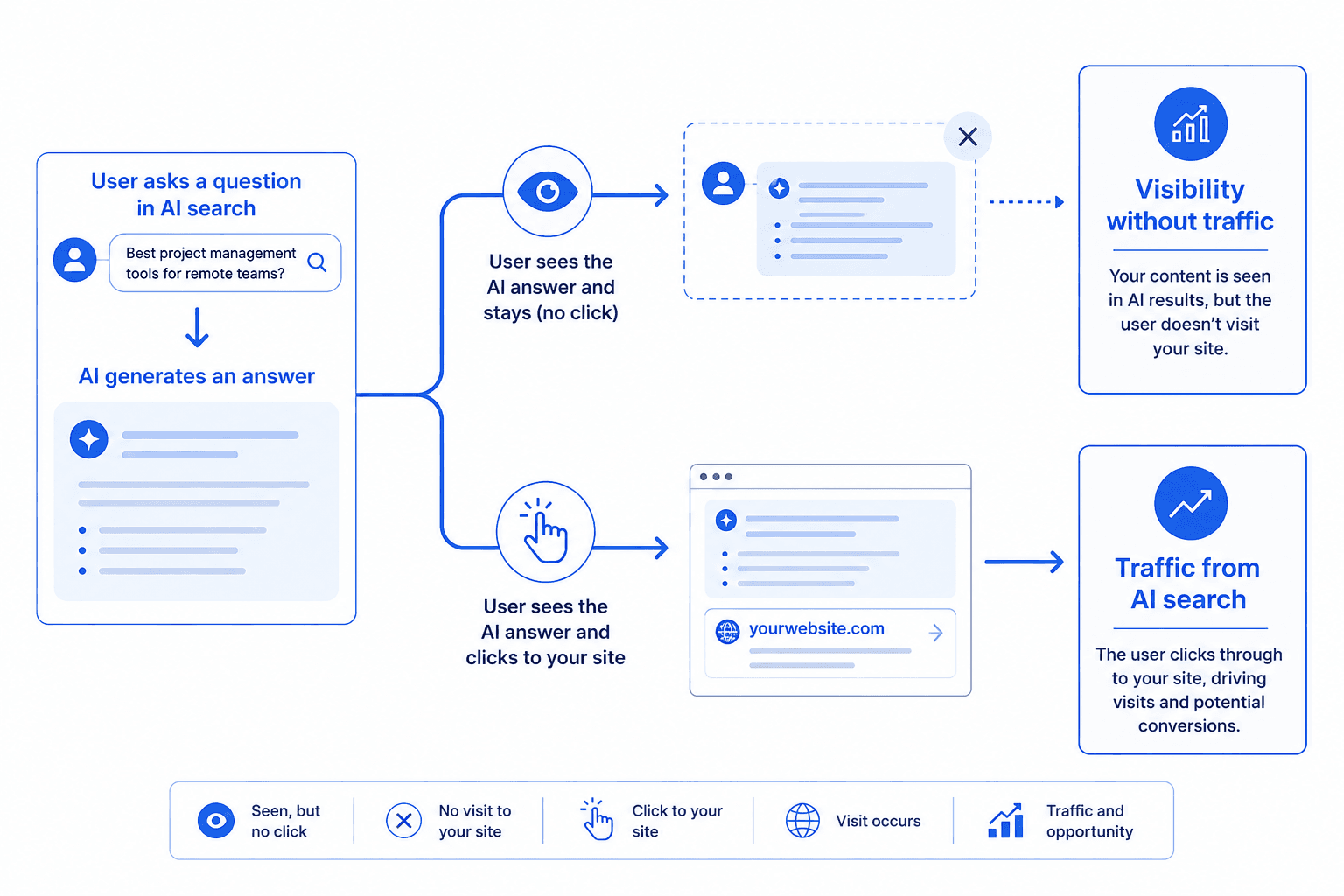
Most SEO dashboards still feed you the same numbers: organic traffic, keyword rankings, click‑through rates. Those worked when search meant a list of blue links. But generative AI answers often give users what they need without asking them to click anywhere. Your brand can appear in a ChatGPT response or a Perplexity summary, yet your monthly report shows zero visits from that source. That gap is why traditional KPIs miss the real picture. You need AI search visibility metrics that measure presence, not just clicks.
The visibility-click gap: When presence does not lead to a visit
Here’s the problem in practice. A user asks, “Which CRM tools work best for small teams?” The AI lists three vendors, explains their strengths, and includes your brand. The user reads the answer, gets what they need, and moves on. They never click a link. Your analytics software records nothing. But your brand just appeared in front of a qualified buyer. That impression builds recall and trust — even without a visit.
This gap isn’t small. AI models pull from training data and live sources. When they cite your content, the exposure happens inside the platform. Users stay inside the chat window. Traditional metrics like impressions (on search engine results pages) don’t count that exposure. Click‑based KPIs ignore it entirely. If you only track traffic, you’ll underestimate your AI search footprint by a wide margin.
Why traffic is still relevant but no longer the lead KPI
Traffic isn’t dead. A click still signals intent — someone wanted to dive deeper. That matters for conversion. But using traffic as the primary measure of AI search performance means you’re looking at a small piece of the picture. Many users never leave the AI interface. They get answers, form opinions, and make decisions without ever bouncing to your site.
Traffic under‑reports AI search impact because the user journey changed. In traditional search, you saw a snippet, clicked, and landed on a page. In AI search, the snippet is the answer. The page visit becomes optional. So tracking only clicks tells you about the fraction of users who chose to click — not about the larger audience that saw your brand in a generative response.
Your dashboard needs to separate “visibility” from “engagement.” Traffic measures engagement. For AI search, you first need to measure visibility — how often your brand appears in generated answers, what context it appears in, and whether the sentiment around it is positive. That is what modern AI search visibility metrics should capture. Traffic still has a place, but it’s a secondary signal, not the lead indicator.
AI Search KPIs
Standard SEO metrics fall short when users never click. The KPIs below were picked because they map directly to how AI models surface and present information. They form the core of any AI search visibility metrics dashboard worth building. Of the set, citation rate gives the clearest signal that the model is not only naming your brand, but using evidence that can be reviewed and improved.
Citation rate: How often your brand appears as a source
Count how many AI responses reference your domain, product, or brand name. Use tools like BrightEdge or an AI-powered crawler to sample your top queries. A brand that appears in 30% of tracked queries has a baseline. If that drops to 15%, something changed in how the model indexes your content. This KPI is the closest thing to a “visibility score” in AI search.
Position consistency: Where your brand shows up in the answer
AI answers don’t have fixed rankings. The same query can place your brand in the first sentence one day and as a citation the next. Log average position across repeated queries. If your brand is consistently in the opening sentence, that builds stronger recall than being buried in a follow-up paragraph. Track this weekly.
Brand sentiment: Positive, neutral, or negative portrayal
Analyze the tone when AI mentions your brand. Negative sentiment spreads fast in summaries. One vendor saw a 40% increase in negative mentions after a data breach — each AI response reinforced the bad news. Use sentiment analysis tools to catch shifts before they compound.
Share of voice (SoV) across AI platforms
Compare how often your brand appears versus competitors for the same queries. SoV in AI search often diverges from traditional SEO. A competitor with lower Google rankings may beat you in ChatGPT because their content structure matches how models extract answers. This gap signals new optimization opportunities.
Influenced conversions: Measuring business impact without clicks
Track assisted conversions using brand search lift and post-AI-exposure behavior. Use GA4’s model comparison tool to isolate paths influenced by AI. If brand search volume jumps after your content appears in AI answers, that’s a strong signal of influenced outcomes. No click needed — the user searched for you later.
These KPIs replace outdated click-only metrics. Start with citation rate and position consistency — the rest builds on them.
AI Search Visibility Metrics
AI search visibility metrics should separate answer presence from evidence quality and business impact. Start with the metrics that can be observed directly in AI answers, then connect them to later demand signals. That prevents the dashboard from turning into a vague score with no operational next step.
Citation rate formula
Citation rate is the percentage of tracked AI-generated answers that cite your brand's domain, an owned page, or a trusted third-party source about your brand.
| Formula | Example |
|---|---|
| Cited AI answers / total tracked AI answers x 100 | 18 cited answers / 60 tracked answers x 100 = 30% citation rate |
Define "citation" before you report it. A bare brand mention is not a citation. A source link to your product page, documentation, research, comparison page, or a credible third-party review can count. If the answer cites a competitor's page that mentions you, record it as a third-party citation and inspect whether the framing is helpful, neutral, or risky.
How to Measure AI Search Visibility
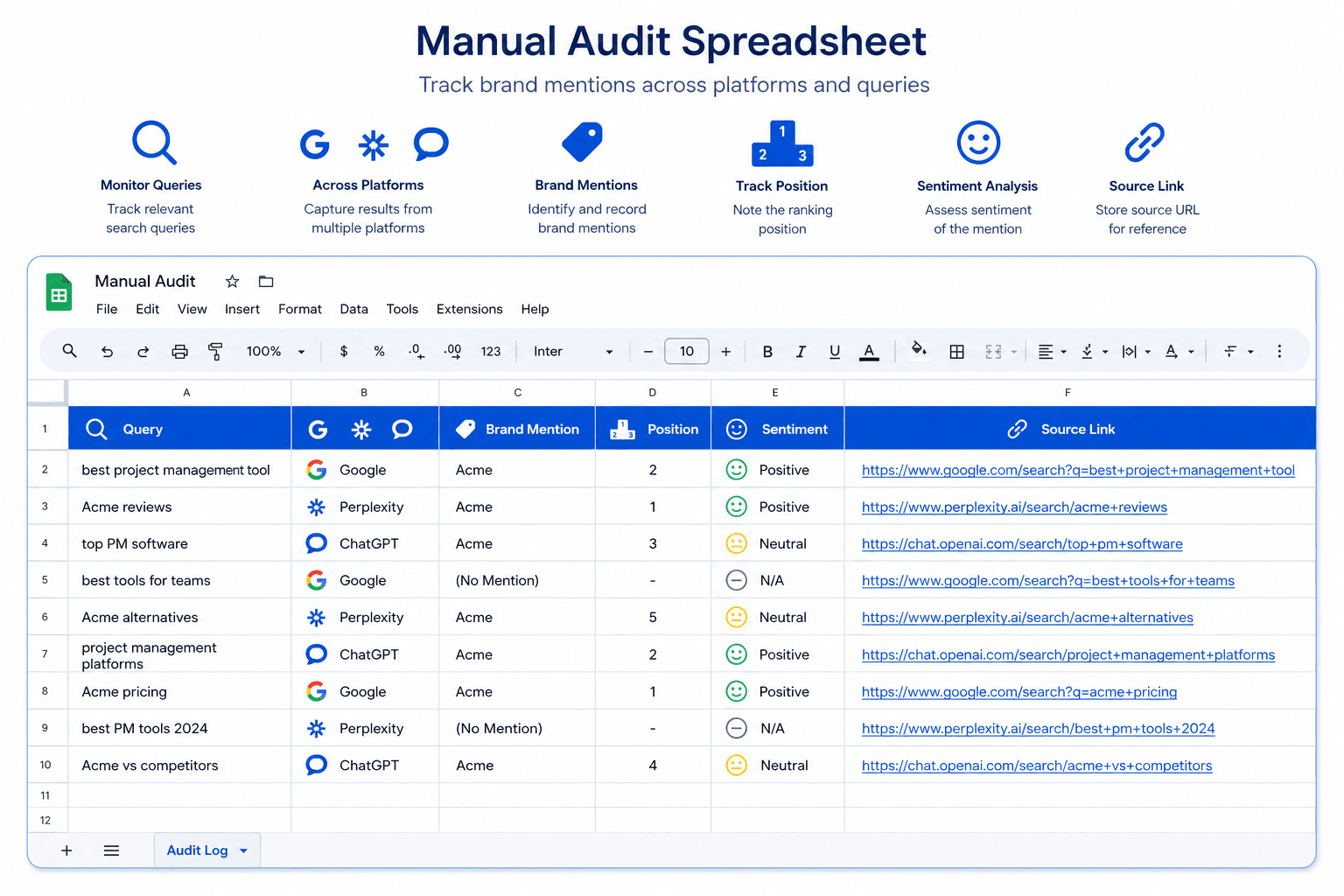
Setting up a manual audit workflow
Start with a list of 50 to 100 core queries that people in your niche actually type. These should cover key products, common problems, and brand-related searches. Don’t guess — pull search data from your Google Search Console or talk to your sales team about real customer questions.
Then prompt each AI platform with the same set of queries. For each answer, record three things: did your brand get mentioned, where in the response it appeared (top, middle, bottom), and whether the tone was neutral, positive, or negative. Also note if a source link was included.
Track per-platform visibility separately: ChatGPT, Gemini, Perplexity, DeepSeek, and Google AI Mode can all use different source mixes. Blending them into one score hides the platform where the real gap is happening.
This table shows what your audit sheet might look like for three example queries:
| Query | ChatGPT result | Perplexity result | Gemini result |
|---|---|---|---|
| "best project management tool for remote teams" | Brand A cited at position 2, neutral, no link | Brand B cited at position 1, positive, link to blog | No brand cited |
| "how to reduce email spam" | Brand C not cited | Brand D cited at end, neutral, link to support page | Brand C cited at position 3, negative |
| "top CRM software 2026" | Brand E cited at position 1, positive, link to landing page | Brand E cited at position 2, positive, link to case study | Brand E not cited |
You can repeat this weekly or monthly to spot changes. A manual audit gives you the baseline data that automated tools often miss — especially subtle shifts in sentiment or position.
Using automated tools for continuous tracking
Manual audits are good for accuracy but don’t scale. For ongoing measurement, use tools that log citations, sentiment, and answer position over time. Some AI-powered rank trackers now offer dashboards for ChatGPT, Perplexity, and Gemini. Look for features like weekly trend graphs and alerts when your brand appears or disappears from a set of queries.
The single most critical insight is that automated tracking only works if you feed it the right query list — the same 50 to 100 queries you validated manually. Without that, you’re measuring noise.
Benchmarking your performance against competitors
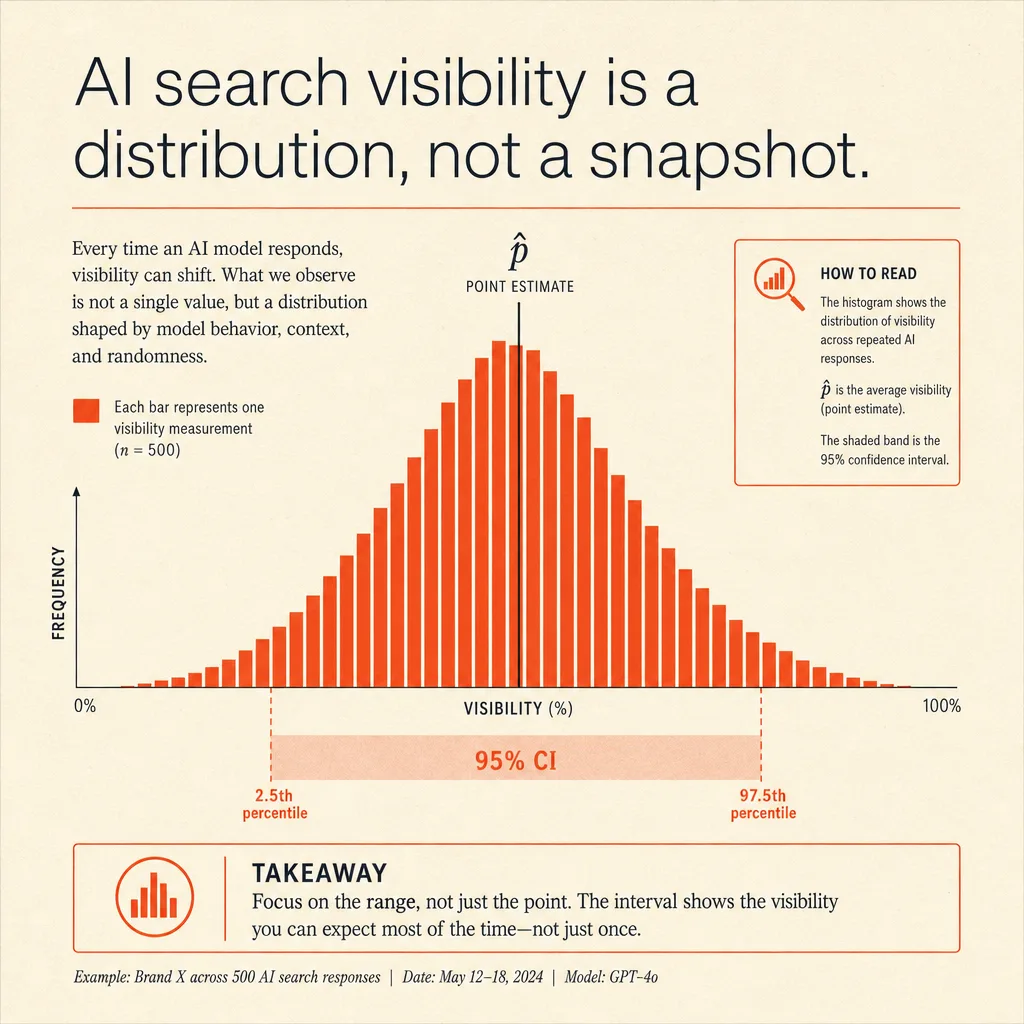
Calculating your share of voice (SoV) per platform is straightforward. Divide the number of times your brand is cited by the total number of citations across all brands in that query set. For example, if your brand appears in 20 out of 100 total citations across your 50 queries, your SoV is 20%.
Run this number for each platform and compare week over week. A drop in SoV after a competitor’s PR event tells you something. A rise after you publish a new guide tells you something else. This is where your AI search visibility KPIs start to show real business value — not as traffic numbers, but as direct signals of brand presence in generative search.
Track your own brand separately by platform, then overlay competitor data. Over a few months, patterns emerge. You can adjust your content strategy based on what each platform favors. That is the point.
AI Search Visibility KPI Framework
A list of metrics means nothing if you can’t act on them. A good dashboard turns AI search visibility KPIs into clear next steps. Here’s what to include and how to connect each chart to a real decision.
Key metrics to include in your dashboard
Use five charts, each answering a different question.
-
Citation rate over time (line chart). Shows whether your brand is getting more or fewer mentions in AI answers. A flat line means your content strategy isn’t keeping up.
-
Average position per platform (number or radar chart). Some platforms rank sources by order of mention. Track your average position across ChatGPT, Perplexity, Gemini, and others.
-
Sentiment breakdown (pie chart: positive / neutral / negative). A citation in a negative context does more harm than no citation. You need to see the split.
-
Share of voice vs. top 3 competitors (vertical bar chart). Compare how often your brand appears against direct competitors for the same high-value queries.
-
Influenced conversions (donut chart showing direct vs. assisted). Track how many conversions started with an AI mention but didn’t end with a click. This proves ROI even when users don’t visit your site.
AI Search Visibility Report Template
Use a report template that keeps prompt evidence, platform coverage, and next actions in the same view. The goal is not to create a prettier dashboard. The goal is to make every metric traceable to a prompt, a cited source, a competitor gap, and a content or source-building action.
| Report field | What to record | Why it matters |
|---|---|---|
| Weekly tracked prompts | Stable buyer, category, comparison, and brand prompts | Keeps week-over-week movement comparable |
| Platform | ChatGPT, Perplexity, Gemini, Google AI Mode, and any priority regional model | Shows where visibility exists or disappears |
| Brand present | Yes or no for each answer | Creates the brand mention rate baseline |
| Answer position | First mention, second mention, later mention, citation only, or absent | Shows prominence beyond raw inclusion |
| Cited URL | Owned URL, third-party URL, competitor URL, or no citation | Turns visibility into source and content priorities |
| Competitor mentioned | Competitors appearing in the same answer | Supports share-of-voice and gap analysis |
| Sentiment | Positive, neutral, mixed, or negative | Surfaces reputation risk inside generated answers |
| Next action | Update page, add FAQ, build comparison page, earn source, monitor only | Forces each KPI to drive a concrete operating step |
For a weekly executive view, roll those rows into five numbers: brand mention rate, citation rate, average answer position, competitor share of voice, and AI search assisted demand. For the execution team, keep the raw prompt rows visible so writers, SEO owners, and digital PR teams can see exactly what to fix.
How to link AI KPIs to content strategy
Each metric points to a specific action.
-
Low citation rate? Your content isn’t authoritative enough. Focus on creating data-backed guides, original research, and expert interviews. Cite credible sources to boost citable trust.
-
Negative sentiment in AI responses? Something in the content the AI is pulling from hurts your reputation. Audit the specific pages or posts that rank in AI snippets. Improve transparency and fix outdated claims.
-
Low share of voice on a high-value query? Build topical depth. Write full articles that cover subtopics the query implies. Earn backlinks from .edu and .gov domains to increase domain authority.
-
High assisted conversions but low direct conversions? Your brand influences buyers even if they don’t click. Report this metric to leadership so they see the full funnel, not just last-click traffic.
How to avoid vanity metrics in AI visibility reports
Three errors kill dashboard usefulness.
- Do not report one blended AI visibility score without showing the underlying prompts, platforms, and source URLs.
- Do not count every brand mention as a win. A negative mention, outdated description, or competitor-owned citation can create risk.
- Do not use AI traffic as the only proof of progress. Many AI search journeys never click, so pair assisted traffic with answer presence, citation rate, and share of voice.
A decision-ready report explains what changed, why it matters, and what the team should do next. Each number should connect to a content update, source-building priority, competitor response, or executive risk note.
How startups should set realistic AI visibility benchmarks
Startups should avoid comparing early AI visibility against mature category leaders. Set benchmarks by prompt tier and platform maturity instead.
| Benchmark area | Practical starting target |
|---|---|
| Brand prompts | Correct brand description in 80% or more of tracked answers |
| Category prompts | Brand appears in 10% to 25% of high-fit unbranded prompts |
| Citation rate | Owned or trusted third-party source cited in 5% to 15% of answers |
| Sentiment | No recurring negative or misleading framing |
| Competitor gap | Know the top three competitors appearing where your brand is absent |
After the baseline, judge progress by movement. A startup moving from zero to five cited answers in a narrow query set has a real signal, even if enterprise competitors still dominate broad category prompts.
Frequently Asked Questions
What are AI search visibility metrics?
AI search visibility metrics are measurements that show whether a brand appears, gets cited, is positioned prominently, and is described accurately in AI-generated answers. Core metrics include brand mention rate, citation rate, answer position, sentiment, competitor share of voice, cited source URLs, and assisted demand signals.
What KPIs measure AI search performance?
The main AI search KPIs are brand mention rate, citation rate, answer position, sentiment, competitor share of voice, source coverage, and AI search assisted demand. They measure whether AI platforms include your brand, cite useful evidence, frame the brand positively, and support later demand.
How do you measure brand visibility in ChatGPT?
Measure brand visibility in ChatGPT by running a stable set of buyer prompts, recording whether your brand appears, where it appears, what sources are cited, which competitors are mentioned, and whether the sentiment is positive, neutral, mixed, or negative. Repeat the same prompt set over time.
What is citation rate in AI search?
Citation rate in AI search is the percentage of tracked AI-generated answers that cite your domain, an owned page, or a trusted third-party source about your brand. The formula is cited AI answers / tracked AI answers x 100.
Are clicks still useful for AI search measurement?
Clicks are still useful, but they should not be the lead KPI. Many AI search journeys never produce a referral visit. Use clicks and traffic as engagement signals, then pair them with brand mention rate, citation rate, answer position, sentiment, and assisted demand.
By focusing on answer presence, citation rate, sentiment, and source-level evidence, you can measure how well your content performs in AI-generated responses and turn visibility data into concrete content action.
Author
Mira Chen
Mira Chen studies how global brands appear in AI answer engines and turns that evidence into practical GEO workflows.