ChatGPT SEO: How to Improve Your Content for AI Search Engines
You can rank first on Google and still not get cited by ChatGPT.
 Mira Chen10 min read
You can rank first on Google and still not get cited by ChatGPT. That's the disconnect driving chatgpt seo — AI models don't crawl your page the way search engines do. They read for clear structure, plain language, and consistent authority across topics. A single high-ranking post won't cut it. This guide shows what actually moves the needle: building topical depth, writing naturally, and formatting data so LLMs can pull it into answers. Here's how to align your content with how AI search works.
What Is ChatGPT SEO and Why Should You Care?
Traditional SEO gets your site to appear in search results. ChatGPT SEO is something different. It’s about making your content easy for AI models to quote directly. When someone asks ChatGPT a question, the model might pull an answer from your page. That can happen even if you’re not ranking first on Google.
The Shift from Search Results to AI Answers
Search engines show ranked links. You click through. ChatGPT gives a direct answer. That changes what matters for your content.
| Traditional SEO | ChatGPT SEO |
|---|---|
| Focus on ranking in a list of links | Focus on being cited as a source in an AI response |
| Users click to your page | Users get the answer without leaving ChatGPT |
| You need high keyword density and backlinks | You need clear structure and plain language |
| Meta descriptions help | The model reads the actual body text |
Users now get answers without clicking through. So your content must be written in a way that ChatGPT can quote directly. That means short, clear sentences. Bullet points or numbered steps. Headers that match common questions. If your page is messy or full of fluff, the model skips it.
Why Your Website Might Already Be in ChatGPT Responses
ChatGPT trains on public web data. That includes Common Crawl snapshots and licensed content from partners. If your site has been publicly available for a while, there’s a good chance ChatGPT has seen parts of it.
To check, ask ChatGPT a question related to your niche. For example, if you run a garden blog, ask: “How do I start a compost pile?” If your site is quoted, you’ll see a small icon next to the answer. Click it to see the source. That’s a quick way to find out if your content is already being used.
Many site owners are surprised to see their pages cited. The model doesn’t care about your domain authority the way Google does. It cares about clear, useful information. If your article explains something step by step, it can get picked up. That’s why understanding chatgpt seo matters now — not later. You don’t need to rewrite everything. You just need to make your best pages easier for AI to read.
How Does ChatGPT Actually Find and Use Your Content?
ChatGPT doesn’t crawl the web like Google. Its knowledge comes from a fixed training set and, for real-time answers, from SearchGPT – a separate retrieval system. If you want ChatGPT to cite your page, you need to understand how that retrieval pipeline works.
SearchGPT uses its own bot. That bot must be allowed through your robots.txt file. If you block it, your content won’t appear in ChatGPT’s live answers. This is where chatgpt seo starts: you can’t get cited if the bot never sees your page.
The Role of Crawling and Indexing for AI Models
SearchGPT’s bot crawls pages the same way Googlebot does, but it reads for structure, not just keywords. Schema markup makes that job easier. When you add FAQ, Article, or HowTo schemas, the bot can pull out questions, answers, and steps clearly. That data then feeds into ChatGPT’s response.
| Schema Type | What It Tells the Bot | Why It Matters for ChatGPT |
|---|---|---|
| FAQPage | List of questions + answers | ChatGPT can quote your Q&A directly |
| Article | Title, author, date, body | Helps attribute the source |
| HowTo | Step-by-step instructions | Turns your guide into a usable summary |
Without these markers, the bot has to guess what your content means. Guessing leads to lower chances of being cited.
What Makes Content ‘Sourceable’ for ChatGPT
ChatGPT prefers content that answers a specific question in plain language. A page that starts with “The average lifespan of a lithium-ion battery is 2-3 years” is more likely to be picked up than one that buries the answer in marketing fluff.
Avoid ambiguous statements. Don’t write “many users find this helpful” – write “87% of testers reported fewer failures over six months.” Concrete numbers and clear claims build trust. Also cite external reputable sources when you can. ChatGPT’s model weighs authority, so linking to known research or official docs helps.
Keep paragraphs short. Use bullet points for lists. The bot reads for clarity the same way a human skims. If your content is easy to scan, it’s easier for the AI to extract.
The most critical insight: Write for a human who wants a fast, straight answer. That’s exactly what ChatGPT looks for. Structure your content with clear headings, direct definitions, and factual examples. That approach works for both your human readers and the AI that might serve them next. For platform-specific tracking, compare your results against ChatGPT visibility metrics instead of treating all AI platforms as one channel.
Key Signals That Help Your Content Get Cited by ChatGPT
Getting cited by ChatGPT isn't the same as ranking high on Google. Traditional SEO focuses on keywords, backlinks, and page speed. ChatGPT SEO is different — AI models look for clear structure, well-connected topics, and machine-readable data. If ChatGPT can't find a clear answer, it won't cite you, no matter where you rank.
Topical Authority and Entity Relationships
ChatGPT prefers content that shows genuine depth on a subject, not just a single post that covers a keyword. A single article about "best running shoes" might rank well on Google, but the AI will look for a broader web of related topics — shoe materials, fit guides, injury prevention, maintenance tips. That's topical authority.
Build it by creating pillar pages that cover a topic from all sides. For example, a page on "running shoe care" that links to sub-pages on cleaning leather vs. mesh, when to replace soles, and how to store shoes. Each sub-page should also link back to the pillar and to each other. This creates entity relationships — the AI can see you're not just writing one article, you're mapping out an entire domain of knowledge.
Internal links matter here. Use descriptive anchor text like "how to clean mesh running shoes" instead of "click here." That helps the AI understand the relationship between your pages. For a GEO-focused internal linking model, use your GEO SEO workflow as the hub and connect supporting articles around it.
Structured Data and Semantic Markup
Raw text is harder for AI to parse. Structured data gives ChatGPT direct access to your content's meaning. Two schemas are most useful:
| Schema Type | What It Does |
|---|---|
| FAQ Schema | Lets ChatGPT pull exact question-answer pairs into its responses. Write clear questions and direct answers. |
| Article Schema | Labels your page as an article with headline, author, and publish date. Helps the AI treat it as authoritative. |
Implementing FAQ schema is straightforward. Add JSON-LD code to your page for each Q&A. ChatGPT will often pull these verbatim when answering user questions. Article schema increases visibility in the AI's context window — it knows the content has a credible source.
A practical tip: keep your answers under 50 words. Long-winded responses confuse the model. Short, factual answers are more likely to be cited.
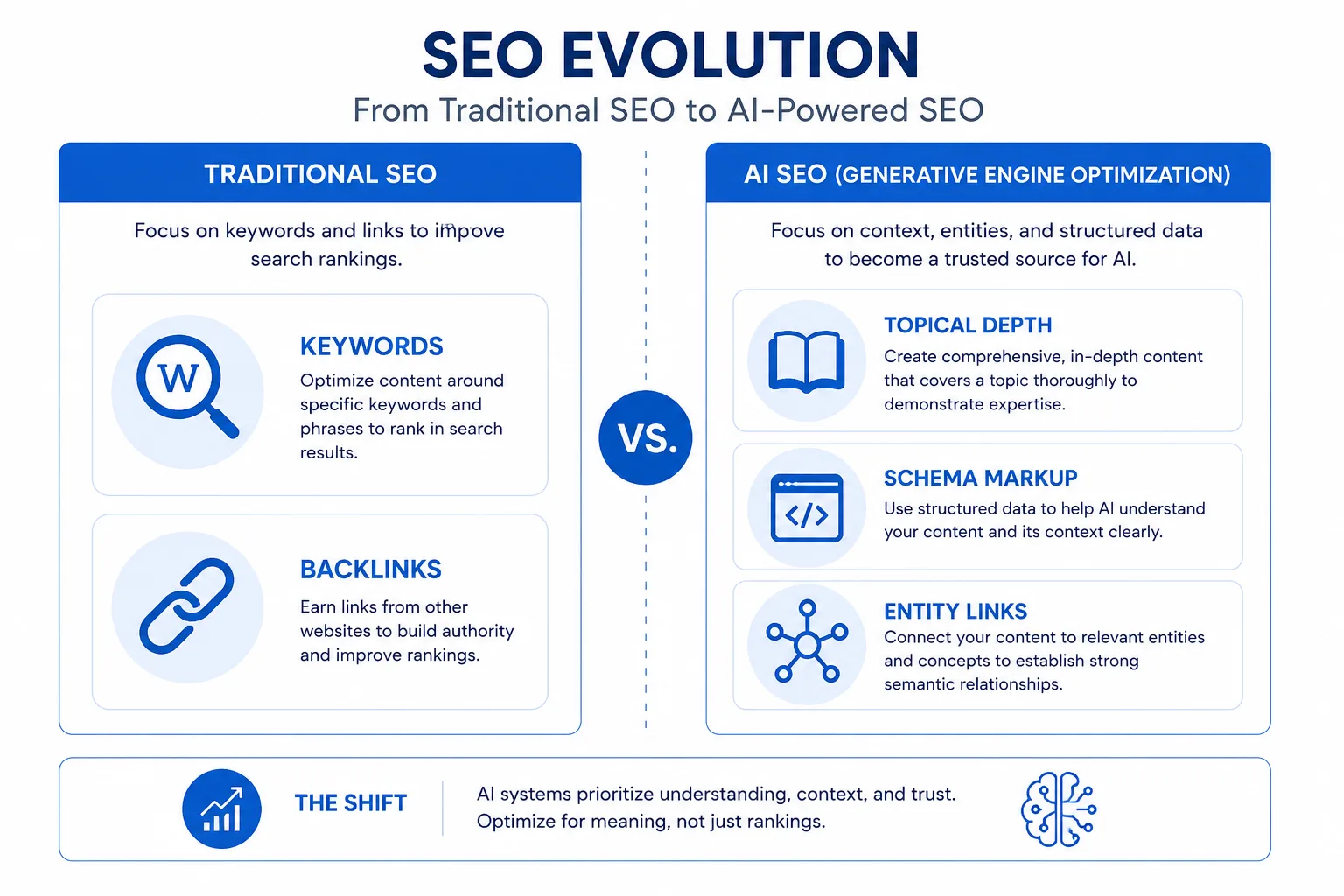
The key takeaway: chatgpt seo is about making your content easy for the AI to understand, not just easy for a search engine to index. Write with depth, link your topics, and mark up your data. That's how you get cited.
Practical Steps to Improve Your Content for ChatGPT Answers
ChatGPT SEO works differently from traditional search optimization. Google ranks pages based on links and keywords. ChatGPT reads for structure, clarity, and consistent authority. If you want your content cited in AI responses, you need to change how you write.
Write Like You're Answering a Question
ChatGPT pulls answers from text that directly addresses a query. So start each paragraph with the answer — then explain why.
Example: instead of "Proper keyword placement matters for visibility," try "Place your main keyword in the first 100 words. That's where both readers and AI models scan first."
Keep sentences short. Use everyday words. If you must use a technical term, explain it right there. A conversational tone helps. But don't be vague. Say "Check your site analytics weekly" not "Periodic review is beneficial."
This approach signals to ChatGPT that your content is a direct, reliable answer. It also helps readers get the point faster.
One key chatgpt seo tactic: write like you're talking to a friend who asked you a specific question. No fluff. No setup. Just the answer, then the details.
Build Authority Through Linked References
ChatGPT trusts content that backs up its claims. So cite official sources, research papers, and recognized industry reports where you can. If you're explaining a Google update, link to Google's own documentation. If you reference a statistic, link to the original study.
Internal links matter too. Connect your article to other relevant content on your site. This creates topic clusters — a group of pages covering one subject in depth. ChatGPT sees those clusters as a sign of authority. If your goal is brand-level visibility rather than article-level citations, pair this guide with a ChatGPT brand visibility audit.
Here's a quick comparison of how different content types affect AI citation:
| Content type | Likelihood of being cited by ChatGPT |
|---|---|
| Single blog post with no sources | Low |
| Post with links to official docs | Medium |
| Topic cluster with internal links + external references | High |
You don't need a dozen links. One or two well-chosen references per section is enough. The goal is to show ChatGPT that your information is grounded. This builds trust over time.
Frequently Asked Questions
Does ChatGPT SEO replace traditional SEO?
No, ChatGPT SEO does not replace traditional SEO. It complements it. Optimizing for AI search still requires strong quality fundamentals, but with extra focus on structured data and clear answer formatting.
How long does it take to see results from ChatGPT SEO?
Results from ChatGPT SEO depend on model updates and real-time retrieval. Consistently publishing high-quality, factual content can show measurable impact within weeks to a few months.
Can I improve for ChatGPT SEO without technical skills?
Yes. Writing clear, factual, Q&A-style content is the easiest tactic for ChatGPT SEO. For advanced techniques like schema markup, you may need help from a developer.
Embracing ChatGPT for SEO means adapting to a landscape where AI-driven content creation and optimization are becoming essential. By using targeted prompts and refining output for search intent, you can maintain relevance and efficiency in your strategy. See how CitedMe tracks ChatGPT SEO across AI platforms.
Author
Mira Chen
Mira Chen studies how global brands appear in AI answer engines and turns that evidence into practical GEO workflows.