AI Search Share of Voice: The Definitive Guide to Measuring and Improving Your Brand's Visibility in LLM Answers
Learn how AI search share of voice measures brand visibility in LLM answers, how to calculate it, and which actions improve citations across AI platforms.
 Mira Chen13 min read
Your website might rank #1 on Google but still be invisible in AI answers. That gap is measured by a new metric: AI search share of voice - the percentage of relevant LLM responses that mention your brand. As models like ChatGPT, Perplexity, Gemini, and Google AI Mode become default answer engines, this number determines whether buyers see your brand or only see competitors. Brands that track it can take focused action: publish authoritative content, strengthen entity associations, and earn third-party citations. This guide explains exactly how to measure your current share of voice and what to do to raise it.
What Is AI Search Share of Voice and Why Does It Matter?
AI search share of voice measures how often your brand appears in responses from ChatGPT, Google AI Overviews, Perplexity, Gemini, or other large language models. Traditional SOV counts your share of ad impressions or organic listings on a search results page. AI SOV counts how many times a model references your brand inside its generated answer. That is a different game entirely.
How AI Share of Voice Differs from Traditional SOV
The table below breaks down the main differences.
| Aspect | Traditional SOV | AI SOV |
|---|---|---|
| What it counts | Ad impressions or organic SERP presence | Mentions in LLM-generated responses |
| How users see it | Click on a search result link | Read the brand name within an AI answer |
| Competition | Many ads and organic results on one page | Usually a small set of cited or recommended sources |
| Optimization needed | SEO, PPC, keyword targeting | Entity clarity, authoritative content, third-party citations |
Traditional SOV rewards you for ranking high on a page with many listings. AI SOV rewards you for being one of the brands a model chooses to mention, cite, or recommend. If the LLM lists five options and yours is not among them, you are invisible for that answer, no matter how high your traditional rank is.
Another difference: LLMs often list multiple sources for a single answer. Winning one citation is not enough. You need consistent appearance across different prompts, platforms, and user variations. A brand cited in 20% of relevant ChatGPT answers has a much stronger position than one cited in 2%.
AI SOV also demands different optimizations. You cannot just repeat keywords. The model looks for entity clarity - does it clearly understand who you are and what you do? - plus an authoritative narrative backed by credible outside sources. SEO alone will not get you there.
Why AI SOV Matters for Your Brand's Future
A growing share of searches now end with a direct answer, not a click. AI overviews and chatbot responses satisfy the user's question on the spot. If your brand is not mentioned in that answer, you lose the chance to be seen at all.
Being cited in AI answers builds top-of-mind awareness. The user does not need to click through to your site. They read your brand name inside a trusted AI response. That exposure shapes perception and recall.
One key insight: high AI SOV correlates with trust. When a model cites you repeatedly, it signals that your content carries weight. Real-world buyers notice that. They are more likely to choose a brand they have seen recommended by an AI system they trust.
The bottom line: AI search share of voice is becoming a direct driver of brand authority. Ignoring it means letting competitors capture mindshare inside the answer engines that more people use every day.
How to Measure Your AI Search Share of Voice
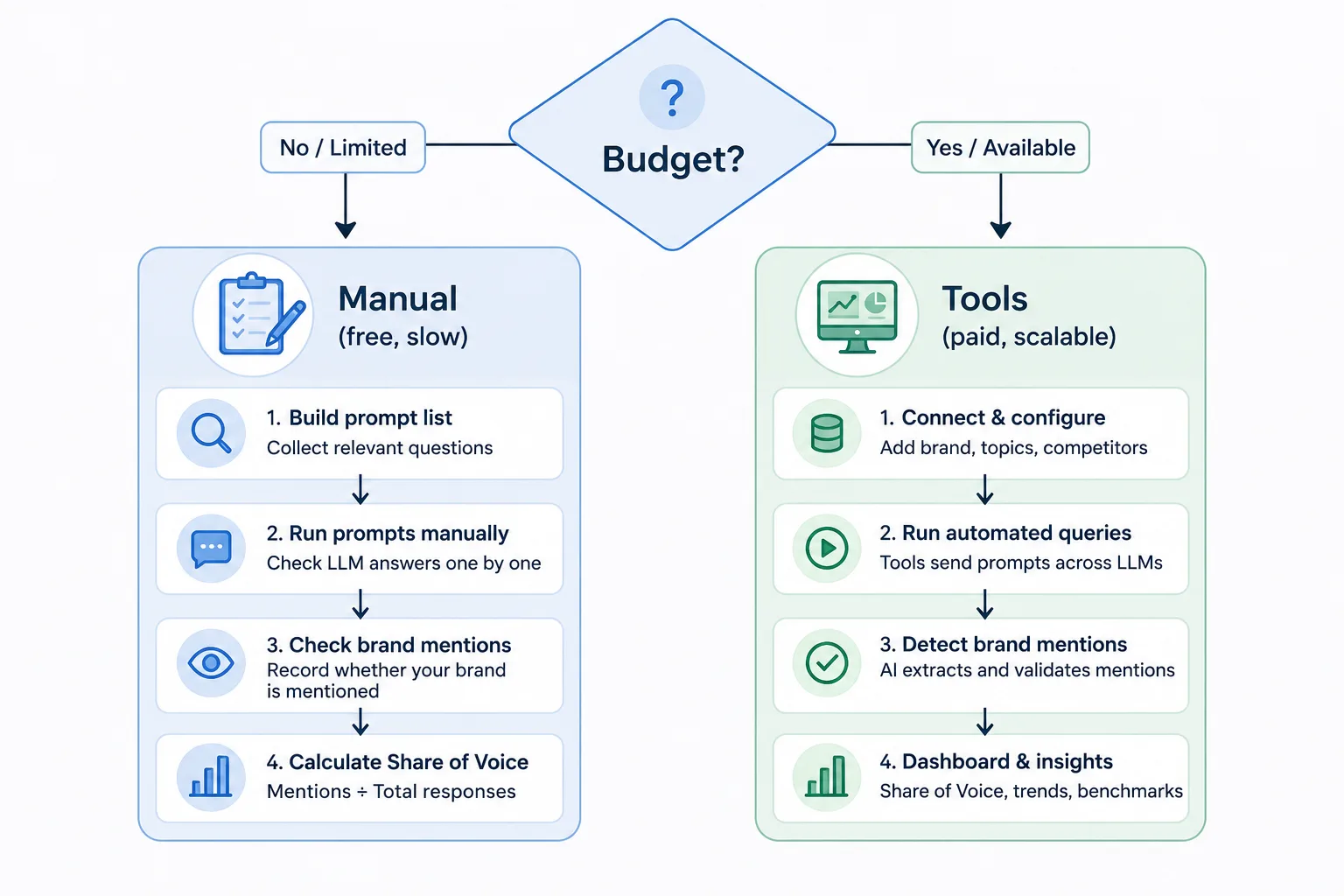
Measuring your AI search share of voice is not complicated, but it takes methodical work. You have two main paths: manual testing or automated tracking. Each has trade-offs in cost, depth, and scalability.
Manual Method: Analyzing LLM Responses for Your Brand
Start by building a list of 10 to 20 key prompts that your target audience actually types. For example, "best CRM for small businesses" or "how to choose a project management tool." Do not guess. Use real search data, customer questions, sales call notes, or support tickets.
Run the exact same prompts across ChatGPT, Gemini, Perplexity, and Copilot. Record five things:
- Whether your brand is mentioned.
- Whether a competitor is mentioned.
- Whether your brand is cited with a URL.
- Where your brand appears in the answer.
- Whether the context is positive, neutral, mixed, or negative.
A simple spreadsheet works for the first pass. This method is free and gives you raw signals. But it is slow. Repeating 20 prompts across four platforms takes hours, and you also miss the nuance of different prompt variations. Still, for a first snapshot, manual sampling beats guessing.
Using SEO Tools for Automated Tracking
Once you need consistent data, dedicated tracking tools save weeks. Below is a quick comparison of common options.
| Tool | How it works | Best for |
|---|---|---|
| Semrush AI Visibility Toolkit | Tracks citation share across multiple prompts and platforms in one dashboard | Brands with 10+ prompts needing monthly reports |
| Nightwatch LLM Tracking | Monitors brand presence and average position in AI answers | Teams that want weekly trend data and alerting |
| CitedMe | Connects AI answer visibility, citations, competitor presence, and action planning | Brand teams that need an operating workflow, not only a visibility score |
Set up a regular schedule. Weekly works for competitive topics; monthly is fine for less volatile ones. Track not just if you appear, but how. Are you referenced in a buying-intent answer or a general definition? Are you cited as the source, or is a competitor's article explaining your category better than you are? That context matters more than raw counts.
For a broader measurement framework, pair this article with AI search visibility metrics and KPIs.
What's a Good AI SOV Score?
There is no universal benchmark yet. As a practical starting point, 10% to 15% share of voice in high-intent topics can be strong for a brand that is not already the category default. But that number shifts by platform. Some LLMs, like Perplexity, lean heavily on fresh web sources and citations. Others may rely more on established entity signals, trusted domains, or source consensus.
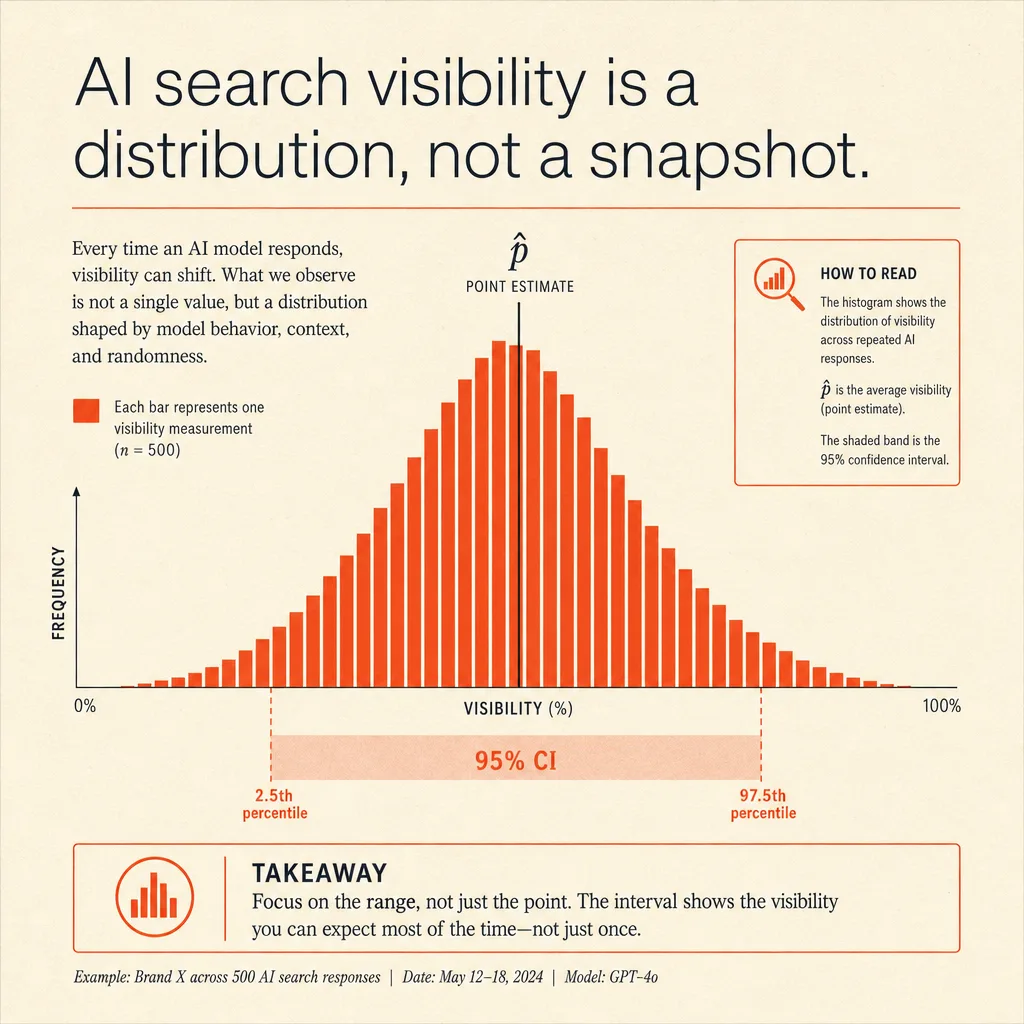
Your focus should be relative improvement over time. If your share of voice goes from 3% to 7% in three months, you are winning. Chasing a fixed number is less useful because models change, competitor content changes, and prompt behavior changes.
The real test: Are you appearing in answers that drive clicks, branded search, direct visits, demo requests, or sales conversations? A high share of voice in low-value queries does not help. Measure your AI search share of voice against your most important search terms, not every possible prompt. That is where improvement pays off.
AI Search Share of Voice Formula
The simplest formula is:
| Metric | Formula | Example |
|---|---|---|
| Brand mention share of voice | Brand mentions / total tracked AI answers x 100 | 12 brand mentions / 60 tracked answers x 100 = 20% |
| Competitive share of voice | Brand mentions / all brand mentions in the prompt set x 100 | Your brand appears 12 times; all competitors appear 48 times; 12 / 60 = 20% |
| Citation share of voice | Answers citing your owned or trusted sources / total tracked AI answers x 100 | 8 cited answers / 60 tracked answers x 100 = 13.3% |
Use all three views. Brand mention SOV tells you whether the model names you. Competitive SOV tells you whether you are winning against alternatives. Citation SOV tells you whether the answer is grounded in sources that you can inspect and improve.
AI Search Share of Voice Report Template
A useful report should make every number traceable to a real prompt, platform, source, and next action.
| Report field | What to record | Why it matters |
|---|---|---|
| Prompt | The exact buyer, category, comparison, or problem query | Keeps results repeatable |
| Platform | ChatGPT, Perplexity, Gemini, Copilot, Google AI Mode | Shows where visibility differs |
| Brand present | Yes or no | Creates the baseline SOV count |
| Competitors present | Names of competitors included in the answer | Enables competitive SOV |
| Position | First mention, second mention, later mention, citation only, or absent | Measures prominence, not only presence |
| Cited URL | Owned page, third-party source, competitor page, or none | Shows what the model trusts |
| Sentiment | Positive, neutral, mixed, or negative | Flags reputation risk |
| Next action | Update page, add FAQ, build comparison page, earn citation, monitor only | Turns measurement into execution |
This template prevents a common mistake: reporting an abstract "AI visibility score" with no explanation of what to fix. If a competitor appears in prompts where you are absent, build missing content. If your brand appears but the answer cites a weak third-party source, improve the source ecosystem. If sentiment is negative, inspect the cited URLs and outdated claims.
Proven Strategies to Improve Your AI Search Share of Voice
Improving AI SOV is not about gaming a single ranking factor. It is about making your brand easier for answer engines to understand, verify, and cite.
Build Content That AI Models Love to Cite
Publish full guides, original research, and data-driven articles that answer specific user questions. Use clear headings, tables, examples, definitions, and short paragraphs so each answer is easy for models to parse. A page that explains a concept, compares options, and supports claims with evidence is easier to cite than a vague marketing page.
Prioritize content formats that answer engines can reuse:
- Category explainers that define the market and your role in it.
- Comparison pages that explain trade-offs without sounding like ad copy.
- Original data, benchmarks, surveys, or research reports.
- FAQs that answer real buyer questions directly.
- Use-case pages tied to specific jobs, industries, or pain points.
Clarify Your Brand Entity Across the Web
AI systems need to understand that your company, product, domain, leadership, and category are connected. Keep your brand description consistent across your website, social profiles, directories, review sites, partner pages, and media mentions.
If one source says you are a "monitoring tool," another says you are an "SEO platform," and your own site says you are a "GEO operating system," models may blend those descriptions into a weak or inaccurate answer. Strong entity clarity improves the odds that AI responses describe your brand correctly.
Earn Third-Party Citations
Models often trust corroboration. Your own site matters, but third-party references can strengthen your presence in AI answers. Focus on sources that already appear in your category's AI responses: review platforms, industry publications, partner sites, analyst pages, podcast transcripts, comparison articles, and credible community discussions.
The goal is not random link building. The goal is source coverage. If an answer engine looks for evidence about the category, your brand should appear in the sources it already uses.
Fill Prompt Gaps Against Competitors
Run competitor prompts and inspect where they appear but you do not. Group gaps by intent:
- Definition prompts, such as "what is [category]?"
- Buying prompts, such as "best [category] tools."
- Comparison prompts, such as "[brand] alternatives."
- Problem prompts, such as "how to solve [pain point]."
- Industry prompts, such as "[category] for SaaS teams."
Each gap should create a specific content or source-building action. If competitors win comparison prompts, build better comparison content. If they win problem prompts, create deeper use-case pages. If they win because third-party sites cite them more often, work on source coverage.
Monitor Changes Over Time
AI SOV is unstable. Model updates, fresh articles, competitor launches, and news events can shift answers quickly. Track weekly for competitive prompt sets and monthly for stable evergreen topics. Keep snapshots of the actual answers, not just the final score, so you can understand why the number moved.
Common Mistakes When Tracking AI SOV
Avoid these traps:
- Counting only citations and ignoring uncited brand mentions.
- Counting all mentions as positive even when the answer is outdated or negative.
- Mixing low-intent and high-intent prompts into one blended score.
- Tracking only one AI platform.
- Changing the prompt set every week, which destroys trend accuracy.
- Treating AI traffic as the whole picture when many AI journeys never click.
The best AI SOV reports separate visibility, prominence, citation quality, sentiment, and business impact. That structure gives the team a real operating view instead of a vanity metric.
Frequently Asked Questions
What is AI search share of voice?
AI search share of voice measures how often your brand appears in AI-generated answers compared with the total prompt set or compared with competitors. For example, if your brand appears in 20 out of 100 tracked AI answers, your brand mention share of voice is 20%.
Why does AI search share of voice matter for my business?
AI search share of voice affects whether buyers see your brand in tools like ChatGPT, Perplexity, Gemini, and Google AI Mode. A higher share means more users encounter your brand inside trusted AI answers, even when they do not click through to your website.
How can I measure AI search share of voice?
Build a stable prompt list, run the same prompts across priority AI platforms, record brand mentions, citations, competitors, position, and sentiment, then calculate your percentage of total answers or total brand mentions. Repeat on a weekly or monthly schedule.
What actions improve AI search share of voice?
Create structured, authoritative content that answers buyer questions directly. Strengthen brand entity clarity, earn third-party citations, improve pages that AI systems already cite, and close prompt gaps where competitors appear but your brand does not.
Is AI search share of voice the same as citation rate?
No. AI search share of voice measures how often your brand appears compared with a prompt set or competitors. Citation rate measures how often AI answers cite your owned or trusted sources. A brand can be mentioned without being cited, and both metrics are useful.
Tracking AI search share of voice helps you understand how often your brand appears in generative AI responses, how competitors are framed, and which sources influence the answer. Use it with AI search visibility metrics to turn visibility data into content, source-building, and brand action.
Author
Mira Chen
Mira Chen studies how global brands appear in AI answer engines and turns that evidence into practical GEO workflows.